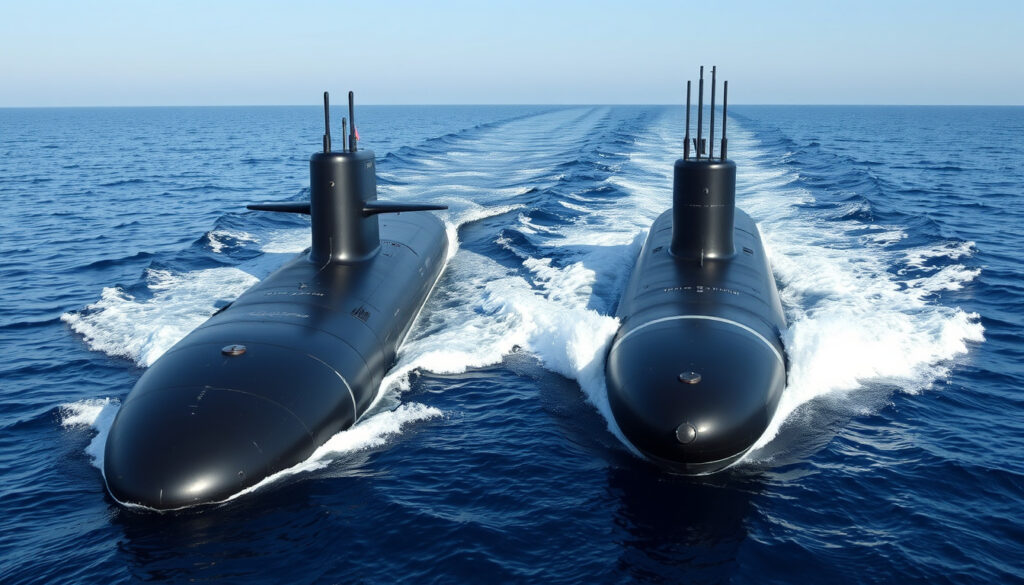
South Korea Submarine Offer to Canada: KSS-III vs TKMS
Canada’s search for new submarines has taken an unexpected turn southward. A South Korean attack submarine just completed a 14,000-kilometer voyage to Canadian waters, and the message from Seoul is blunt: pick us, or we walk.
Procurement Value: $60-120B CAD · New Submarines Planned: Up to 12 · South Korean Bidder: Hanwha Ocean KSS-III · German Competitor: ThyssenKrupp Marine Systems · Program Onset: 2021
Quick snapshot
- Hanwha and TKMS shortlisted (Thelec)
- Final proposals submitted March 2, 2026 (Chosun)
- Up to 12 submarines planned (Korea Times)
- Final contract timeline
- Bid winner selection
- Exact delivery dates beyond targets
- Bids paused until April 29, 2026 (CanadaDefence YouTube)
- Decision expected spring/summer 2026 (Philippe Lagasse)
- First delivery target: 2035 (CanadaDefence YouTube)
- Revised bids due April 29, 2026
- Potential split order under discussion
- Contract decision imminent
| Field | Value |
|---|---|
| Procurement Program | Canadian Patrol Submarine Project |
| Shortlisted Models | KSS-III, TKMS |
| Delivery Goal | First sub this decade |
| Voyage Milestone | South Korean sub to Canada 2026 |
| Canada Military Rank | 28th globally |
Where did Canada get their submarines?
Canada’s current submarine fleet traces its roots to an unlikely transaction across the Atlantic. The Royal Canadian Navy operates four Victoria-class submarines, acquired from the United Kingdom in the late 1990s and early 2000s—a deal that seemed sensible at the time but has aged into a maintenance nightmare.
Victoria-class origins
Britain built these vessels in the 1980s and 1990s, selling them to Canada after retiring them from Royal Navy service. The submarines arrived in Canada between 1998 and 2000, already showing their age. Decades later, they remain the backbone of Canada’s undersea capability—a fleet that defense analysts describe as chronically underfunded and frequently sidelined by repairs.
The Victoria-class has logged countless hours in drydock. Canada’s submarines spent much of the 2010s unable to put to sea, a situation that embarrassed military planners and alarmed allies. The CPSP exists precisely because these boats are reaching the end of their serviceable life with no viable replacement on the horizon.
How many submarines does Canada have now?
The Royal Canadian Navy fields exactly four operational submarines, all belonging to the Victoria class. That’s it. For a country with coastlines on three oceans—Pacific, Atlantic, and Arctic—this is a remarkably thin margin for error.
Current fleet status
Each Victoria-class submarine displacement roughly 2,000 tonnes when submerged, these diesel-electric boats serve the Royal Canadian Navy alongside surface combatants and auxiliary vessels. Their operational tempo has improved in recent years, but the fleet’s small size means that losing even one boat to maintenance creates immediate capability gaps.
Military analysts note that Canada’s submarine count ranks well below comparable nations. Australia operates a dozen nuclearpowered submarines through its AUKUS partnership. Norway fields a modern fleet optimized for North Atlantic operations. Even mid-sized naval powers typically maintain six to ten undersea vessels.
How many submarines does South Korea have?
South Korea’s submarine fleet tells a different story entirely. The Republic of Korea Navy operates three KSS-III Batch-I submarines, with the first unit delivered in 2021—a remarkably recent entry into service for a major attack submarine class. The ROK Navy’s ambitions don’t stop there.
South Korea submarine capabilities
Hanwha Ocean’s Geoje shipyard employs over 31,000 personnel and currently constructs three KSS-III Batch-II submarines simultaneously, according to Hanwha’s production documentation. The first Batch-II unit launched in October 2025, meaning this design is not theoretical—it’s actively entering the fleet.
The KSS-III CPS, the export variant proposed to Canada, features Lithium-ion batteries and an Air-Independent Propulsion system, offering over 7,000 nautical miles of submerged endurance. Hanwha claims this range supports operations across Canada’s three ocean strategy—Pacific, Atlantic, and Arctic—though actual Arctic performance remains unproven in operational trials.
South Korea is not asking Canada to buy an untested design. Three KSS-III Batch-I boats already serve the ROK Navy, and the Batch-II line is in active production. That’s a different sales pitch than buying blueprints.
Why doesn’t Canada buy nuclear submarines?
The question surfaces every time Canada’s submarine gap makes news. Australia just committed to nuclearpowered submarines through AUKUS. Britain, the United States, and France operate exclusively nuclear fleets. So why is Canada sticking with conventional submarines for its next generation?
Conventional vs nuclear rationale
Canada’s Industrial Benefits Requirements policy requires that defense contracts generate industrial activity equal to the full contract value within Canadian borders. A nuclear submarine program would demand specialized infrastructure—fuel handling, reactor maintenance, nuclear-certified yards—that simply does not exist in Canada at commercial scale.
Building that infrastructure from scratch would cost billions and take decades. Conventional submarines, by contrast, can be supported with existing or developable Canadian industrial capacity. The Hanwha economic proposal projects 22,500 annual jobs through 2044 if awarded the full contract—a figure that appeals to the government for obvious reasons.
There’s also a political dimension. Nuclear submarines carry nuclear weapons—or at least, their host nations do. Canada’s identity as a non-nuclear-weapons state under the Nuclear Non-Proliferation Treaty creates diplomatic friction around hosting nuclearpowered vessels, even those without nuclear arms on board.
Which country has the best submarines?
Ranking naval hardware requires context. The United States Ohio-class and Virginia-class boats set the standard for strategic deterrence and attack operations. Britain’s Astute-class matches that quality for different operational priorities. France’s Barracuda-class offers another tier of advanced capability.
Rankings and KSS-III position
For conventional attack submarines in the 2,000-3,000 tonne displacement range, the landscape includes Japan’s Soryu-class, Germany’s Type-212CD (the TKMS offering), South Korea’s KSS-III, and France’s Scorpène export variants. Each design optimizes for different priorities: stealth, endurance, sensors, or weapons load.
The KSS-III positions itself as a mid-weight contender with modern battery technology and AIP endurance. Its state-of-the-art sonar and acoustic tiles for stealth compete directly with Hanwha’s published specifications. The Type-212CD from TKMS offers German engineering pedigree and proven NATO interoperability.
Neither design matches the endurance or speed of nuclear powerplants, but for Canada’s defensive priorities—coastal surveillance, intelligence gathering, and Arctic presence—conventional submarines with advanced batteries represent a capable middle ground.
Comparing the bidders: KSS-III vs Type-212CD
Two shipbuilders, two submarines, one contract worth up to $120 billion CAD. The comparison table below outlines where each design stands on the specifications most relevant to Canada’s needs.
| Specification | Hanwha KSS-III Batch-II | TKMS Type-212CD |
|---|---|---|
| First operational service | 2021 (Batch-I) | 2025 (projected) |
| Current construction status | 3 Batch-II hulls in production | Prototype phase |
| Battery technology | Lithium-ion | Lead-acid with AIP |
| Submerged endurance | 7,000+ nautical miles | ~2,000 nautical miles |
| Optimized for | ASW, ASuW, ISR, minelaying | Multi-mission NATO operations |
| Production capacity | 31,000-person shipyard | Distributed European facilities |
| Delivery claim (first boat) | 2032 if contracted 2026 | 2035 target |
| Full fleet delivery | 2043 | TBD |
The data reveals a stark production-maturity gap: Hanwha’s KSS-III is already operational while TKMS’s Type-212CD remains in prototype phase, potentially giving South Korea a decisive edge in delivery speed.
Pros and Cons: South Korean bid
Upsides
- Proven in-service design with ROK Navy
- Fastest delivery timeline: first boat 2032, fleet by 2043
- Massive production capacity at Geoje shipyard
- Substantial economic benefit claims: 22,500 annual jobs
- Active demonstration underway with ROKS Dosan Ahn Chang-ho in Canada
Downsides
- Split-order threat from Seoul: reduced investments if Canada buys six instead of twelve
- Arctic operations remain untested in actual conditions
- No NATO interoperability track record
- Longer logistics tail for maintenance and parts
- Less mature export support network
The downsizes reflect genuine procurement risks. Canada’s planners must weigh the speed advantage against interoperability concerns that could complicate joint operations with NATO allies.
The 14,000-kilometer demonstration voyage
Hanwha’s most visible play in this competition is not a PowerPoint presentation—it’s a submarine. The ROKS Dosan Ahn Chang-ho, a KSS-III Batch-I vessel, deployed on a 14,000-kilometer mission to Canada in 2026 specifically for trials tied to the CPSP evaluation, according to Army Recognition.
The submarine completed its first leg of the Indo-Pacific voyage to Canada in April 2026, heading toward British Columbia as part of Hanwha’s bid demonstration, Philippe Lagasse reported on his defense policy Substack. This is not coincidence—Hanwha wants Canadian naval planners to see the KSS-III operating in conditions resembling Canada’s own waters.
The demonstration comes at a delicate moment. The Defence Investment Agency, led by Doug Guzman, paused the competition in April 2026 and demanded improved offers from both Hanwha and TKMS by April 29, 2026, according to CanadaDefence YouTube reporting. The agency is shopping for the best value—or possibly seeking leverage to extract concessions from both bidders.
A live demonstration matters. Numbers on paper don’t capture how a submarine handles in Pacific swell or how its crew manages watch rotations. Hanwha is betting that showing up in person beats sending brochures.
Industrial benefits: Canada’s hidden priority
Canada’s Industrial Benefits Requirements mandate that defense contracts generate economic activity equal to the full contract value within Canadian borders. For a $60-120 billion program, that means Hanwha and TKMS must demonstrate substantial Canadian content—or find themselves disqualified on policy grounds regardless of technical merit.
Hanwha’s proposal projects 22,500 annual jobs through 2044, with economic benefits exceeding $60 billion from 2026-2044, per KPMG analysis cited by Hanwha. These figures represent Hanwha’s case for why Canadian industry should want this contract—not just Canadian defense planners.
TKMS brings European industrial partnerships and potential NATO-aligned supply chains, but its Canadian content proposition remains less publicly detailed. The split-order scenario—six boats from each builder—partly reflects an attempt to divide industrial benefits across two industrial bases rather than concentrating them in one.
South Korea’s Industry Minister Kim Jung-kwan put it bluntly: “Of course, we have been trying to win an order for 12 submarines. However, it totally depends on the Canadian government’s decision,” according to Korea Times. A split order, Seoul warned, triggers reduced investments in Canada.
Key timeline: How we got here
| Date | Event |
|---|---|
| 2021 | Program onset, options shortlisted |
| 2025 | Hanwha and TKMS shortlisted as preferred bidders |
| October 2025 | First KSS-III Batch-II launched |
| March 2, 2026 | Hanwha and TKMS submit final proposals |
| April 2026 | Defence Investment Agency pauses competition, demands revised offers by April 29 |
| April 2026 | ROKS Dosan Ahn Chang-ho arrives for Canadian trials |
| Spring/Summer 2026 | Expected decision on preferred bidder |
| 2032 | First KSS-III delivery (if Hanwha wins) |
| 2035 | First delivery target for CPSP |
| 2043 | Full 12-submarine fleet delivery |
The timeline shows a compressed decision window. With bids due April 29 and a decision expected spring/summer 2026, Ottawa is moving quickly—which could favor whichever bidder demonstrates the most readiness.
What remains confirmed and unclear
Confirmed
- Hanwha KSS-III and TKMS Type-212CD shortlisted
- Final proposals submitted March 2, 2026
- Up to 12 submarines planned
- ROKS Dosan Ahn Chang-ho deployed to Canada for trials
- Bids paused until April 29, 2026
- First delivery target: 2035
Unclear
- Final contract award date
- Whether Canada will select one or both bidders
- Exact delivery schedule beyond targets
- Canadian industrial content details from TKMS
- Arctic performance validation for KSS-III
- Revised bid contents after April 29 deadline
The uncertain items represent procurement variables that could shift the outcome. Canada’s final choice will depend heavily on what revised bids deliver by April 29.
What experts are saying
Hanwha has been direct in its pitch. A company representative told Hanwha’s official press release: “It was a great pleasure to host Secretary of State Fuhr at our shipyard today and show him the proven, in-service and in-production KSS-III submarine that we feel is the best submarine for the Canadian Patrol Submarine Project.”
“Of course, we have been trying to win an order for 12 submarines. However, it totally depends on the Canadian government’s decision.”
— Kim Jung-kwan, South Korean Industry Minister, via Korea Times
The stakes extend beyond procurement metrics. Defence analysts note that Canada’s submarine decision signals broader strategic orientation—whether the Royal Canadian Navy prioritizes Indo-Pacific partnerships with democracies like South Korea or maintains traditional transatlantic ties with European NATO allies through Germany.
Bottom line
Canada’s submarine gap is not theoretical—it’s operational reality today, and every year of delay widens the risk. Hanwha Ocean offers a proven, in-production submarine with the fastest path to water: first boat by 2032, full fleet by 2043. TKMS offers German engineering quality and NATO interoperability that Canadian planners may value more highly than delivery speed.
For Canadian defense planners, the calculus is straightforward: accept a proven design with industrial benefits attached and a 14,000-kilometer demonstration voyage, or bet on a newer European design with potentially longer timelines but stronger alliance credentials. The April 29 deadline signals that Ottawa wants both bidders to improve their offers—and that the government holds leverage it intends to use.
For South Korea, the message from Industry Minister Kim Jung-kwan is equally clear: walk away with the full twelve-boat contract or reconsider investment commitments to Canada entirely. A split order is the red line Seoul has drawn.
The decision will define Canada’s undersea capability for the next half-century. What’s at stake is not merely which submarine enters service, but which industrial and strategic partnerships shape that capability for decades to come.
Hanwha Ocean’s KSS-III, fresh from a 14,000 km voyage across the Pacific, bolsters South Korea’s $20B KSS-III bid in Canada’s fiercely contested $60-120B submarine project against Germany’s TKMS.
Frequently asked questions
What is South Korea’s submarine offer to Canada?
Hanwha Ocean proposes supplying up to twelve KSS-III Batch-II conventional submarines through Canada’s Canadian Patrol Submarine Project. The offer includes a delivery timeline of first boat by 2032 and full fleet delivery by 2043, along with projected industrial benefits of 22,500 annual jobs in Canada through 2044.
What is the KSS-III submarine?
The KSS-III is South Korea’s homegrown attack submarine design operated by the Republic of Korea Navy. Three Batch-I units entered service starting in 2021, with three Batch-II hulls currently under construction. The design features Lithium-ion batteries, Air-Independent Propulsion, and over 7,000 nautical miles of submerged range. Hanwha is proposing the KSS-III CPS export variant to Canada.
What is Hanwha’s connection to Canada?
Hanwha Ocean has been cultivating relationships in Canada as part of its CPSP bid. The company opened its Canadian office and has been conducting port visits and demonstrations. South Korea’s Industry Minister has publicly linked broader Korean investment in Canada to the submarine contract outcome, suggesting the industrial relationship extends beyond naval procurement.
What is TKMS offering Canada?
ThyssenKrupp Marine Systems offers the Type-212CD, a German-designed conventional submarine. The design represents an evolution of Germany’s proven Type-212 family, adapted for higher operational demands. TKMS was shortlisted alongside Hanwha and submitted final proposals on March 2, 2026. Under a split-order scenario, TKMS would supply six submarines for Canada’s Atlantic fleet.
Which country has the most powerful submarines?
The United States operates the most advanced and largest fleet of nuclearpowered submarines, including Ohio-class ballistic missile submarines and Virginia-class attack submarines. For conventional submarines, major operators include Japan, South Korea, Germany, and France. Rankings depend heavily on mission profile—strategic deterrence favors nuclear boats, while patrol operations suit conventional designs like the KSS-III.
How many submarines does Canada need?
The CPSP targets up to twelve new submarines to replace the current four Victoria-class vessels. Military analysts generally agree that twelve boats provide the minimum sustainable fleet for operations across three oceans while accommodating maintenance cycles, training requirements, and availability rates. Canada’s current fleet of four is widely considered inadequate for the country’s geographic scope.
When will Canada receive its new submarines?
The CPSP target calls for first deliveries in the mid-2030s. Hanwha’s proposal claims first KSS-III delivery by 2032 if contracted in 2026, with additional boats delivered at one per year through full fleet completion around 2043. TKMS has not publicly disclosed specific delivery projections but faces the same 2035 first-delivery target. The April 29, 2026 bid revision deadline may affect these timelines.
Why is delivery speed important for Canada’s decision?
Canada’s Victoria-class submarines are aging out of serviceability. Each year without a replacement capability increases operational risk for the Royal Canadian Navy. Hanwha’s delivery timeline advantage—potentially two to three years faster than TKMS—could be decisive if Canada’s planners determine that timeline matters more than NATO interoperability credentials or European industrial partnerships.
More related posts
 Karine Gonthier-Hyndman: Biography, Age & Filmography
 Bears vs Vikings Match Player Stats: 19-17 Final
 Toronto Blue Jays Players 2026: Roster, Salaries & Top Stars
 Condos for Rent Toronto: 8,700+ Listings by Neighborhood
 Alex Lifeson: Rush Guitarist, Pilot, and Painter
 Canadian Premier League Standings 2026: Live CPL Table
 England v New Zealand Scorecard 2026: Live & Head-to-Head
 Celta Vigo vs FC Barcelona Lineups – Predicted XIs, Injuries & News
