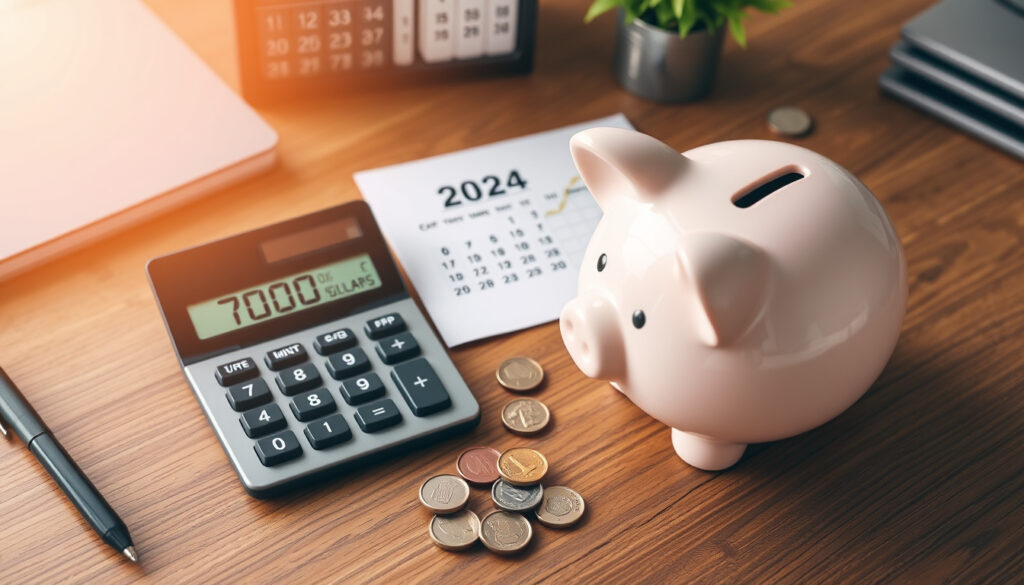
2024 TFSA Contribution Limit: $7,000 Rules & Calculator
If you’ve been putting off opening a Tax-Free Savings Account, the numbers might surprise you. The 2024 annual contribution limit sits at $7,000 — up from $6,500 just a year earlier — and for someone who’s never contributed a penny since becoming eligible in 2009, that adds up to $95,000 in cumulative room waiting to be used. This guide walks you through exactly how that room works, how to check yours using the official CRA calculator, and the penalties you’ll want to sidestep.
2024 Annual Limit: $7,000 · Cumulative Room (from 2009): $95,000 · 2023 Annual Limit: $6,500 · 2026 Projected Limit: $7,000 · Available Room Example (2024): $13,500
Quick snapshot
- The 2024 TFSA dollar limit is $7,000 per year (Canada Revenue Agency)
- Personal room varies by individual history; exact amounts depend on your prior contribution and withdrawal record
- Room resets each January 1; 2025 records processed by April 2026 (Canada Revenue Agency)
- 2025 and 2026 limits projected at $7,000; cumulative room could reach $109,000 by 2026 (Globe & Mail TFSA calculator)
The key facts below summarize the 2024 TFSA limits and penalty rules you need to know.
| Label | Value |
|---|---|
| 2024 Limit | $7,000 |
| 2023 Limit | $6,500 |
| Cumulative (2009-2024) | $95,000 |
| Overcontribution Penalty | 1% per month |
| Room Reset | January 1 annually |
What is the TFSA contribution limit for 2024?
The TFSA dollar limit for 2024 is set at $7,000, according to the Canada Revenue Agency (CRA official calculator page). This is a fixed annual ceiling — it doesn’t roll over if you don’t use it, but it builds on top of whatever room you’ve never touched before.
Annual dollar limit
The annual dollar limit is the maximum you can contribute in any given calendar year. For 2024, that number is $7,000. Limits are indexed to inflation and rounded to the nearest $500, according to Million Dollar Journey (historical limit analysis).
Total available room
Your personal contribution room equals the current year dollar limit plus unused room from prior years plus prior year withdrawals minus current year contributions. The cumulative TFSA limit for 2024 is $95,000 for those who have been eligible since 2009 with no prior contributions, as noted by financial calculators tracking CRA data (Globe & Mail TFSA calculator).
How to check personal room
CRA My Account provides a TFSA contribution room calculator under Savings and pension plans, then View TFSA details, then Contribution room. The CRA itself states that the most reliable way to know how much you can contribute is to calculate your available contribution room, as shown on the official page (Canada Revenue Agency).
How much can I put in a TFSA if I’ve never contributed?
If you’ve never contributed to a TFSA and became eligible in 2009, your total available room by 2024 is $95,000. That number represents 16 years of annual contribution room stacking up because unused limits carry forward indefinitely.
Cumulative room calculation
TFSA contribution room grows each year for individuals who were 18 or older in 2009, even without filing taxes or opening a TFSA, according to the CRA Guide RC4466 (Canada Revenue Agency TFSA Guide). Room starts accumulating from the year you turn 18, and carries forward if you never contribute.
Limits from 2009 to 2024
The annual limits since TFSA introduction in 2009 have been: $5,000 (2009-2012), $5,500 (2013-2014), $10,000 in 2015 alone, then $5,500 again in 2016, with gradual increases through $6,000 (2022), $6,500 (2023), and $7,000 (2024). The cumulative total for someone untouched since 2009 reaches $95,000 by the end of 2024, per Globe & Mail calculations (Globe & Mail TFSA limit tracking).
Using CRA calculator
The CRA My Account online calculator eliminates manual math. Under Savings and pension plans, select View TFSA details, then Contribution room. The system pulls your actual contribution history from CRA records. For manual tracking, the CRA RC343 worksheet is available as a downloadable PDF from Canada.ca (Canada Revenue Agency Form RC343).
Can I max out my TFSA all at once?
Yes — if your available contribution room supports it, you can contribute the full amount in a single transaction. There’s no requirement to spread contributions across the year.
One-time contribution rules
The annual dollar limit caps how much you can put in per calendar year, but your personal contribution room may be higher. If you have $30,000 in unused room accumulated over several years, you can contribute $30,000 at once — as long as it doesn’t exceed your total available room. Only contributions made under a valid Social Insurance Number are accepted, per the CRA Guide (Canada Revenue Agency Guide RC4466).
Withdrawal and re-contribution
Withdrawals from TFSA regain contribution room on January 1 of the following year, not immediately. The CRA processes TFSA records annually, with 2025 records available by April 2026 (Canada Revenue Agency). If you withdraw in March 2024, that room doesn’t reappear until January 1, 2025.
Risks of overcontribution
Over-contributing to a TFSA incurs a 1% per month penalty on the excess amount, according to Globe & Mail analysis (Globe & Mail penalty reporting). The penalty applies month-over-month until the excess is removed. Contributions reduce available room immediately, but CRA account updates can lag — that’s why tracking your own contributions matters.
You can deposit $20,000 or $50,000 in one shot only if your accumulated room supports it. The moment your contributions exceed your available room, the 1% monthly penalty kicks in — and it compounds.
What are the 5 mistakes you must avoid in a TFSA?
Even well-intentioned TFSA holders stumble into penalties because they misunderstand how room works. Five mistakes come up repeatedly in CRA guidance and financial education resources.
Common errors listed
- Not tracking cumulative room year-over-year — the most common error, especially when you’ve had gaps in contributing
- Ignoring the one-year delay on withdrawal room restoration — contributing again after a withdrawal before January 1 triggers overcontribution
- Assuming provincial age of majority applies uniformly — most provinces use 18, but some variations exist that affect eligibility start date
- Contributing as a non-resident without understanding the 1% monthly tax applied to contributions during non-residency
- Not keeping personal records — CRA My Account may lag behind actual transactions, so self-tracking is essential
Overcontribution pitfalls
If you overcontribute, you must withdraw the excess amount and file a TFSA Return form with the CRA, as explained by MoneySense (MoneySense TFSA guide). The penalty accrues from the month the excess first appeared — every month you leave it in adds another 1%.
Tracking room annually
Third-party calculators are for educational purposes and not for official tracking, warns GetSmarterAboutMoney.ca (GetSmarterAboutMoney.ca). Use CRA My Account as your authoritative source, and maintain your own spreadsheet with contribution dates, amounts, and available room after each transaction.
The TFSA rewards consistency: contributing something every year beats a lump-sum years later, because room doesn’t retroactively multiply. The penalty for guessing wrong, though, is immediate and monthly.
What are TFSA contribution limits for other years?
TFSA limits have moved in one direction since the program’s 2016 reset: up. Understanding the year-by-year schedule helps you verify your own cumulative room and spot where past unused contributions might be hiding.
2023 limit
The 2023 TFSA annual limit was $6,500, as tracked by Globe & Mail’s historical limit table (Globe & Mail calculator). That $500 increase from 2022’s $6,000 followed the standard inflation-indexing formula.
2025 and 2026 projections
Based on the indexing formula and current projections, the 2025 annual limit is expected to remain at $7,000, with the cumulative total reaching $102,000 for those with full history. By 2026, the cumulative figure could hit $109,000, according to financial calculators using CRA indexing data (MoneySense projections).
Historical table
The table below shows every annual TFSA limit since 2009 and the cumulative total for someone with no prior contributions.
| Year | Annual Limit | Cumulative (from 2009) |
|---|---|---|
| 2009–2012 | $5,000 | $20,000 |
| 2013–2014 | $5,500 | $31,000 |
| 2015 | $10,000 | $41,000 |
| 2016–2018 | $5,500 | $57,500 |
| 2019 | $6,000 | $63,500 |
| 2020 | $6,000 | $69,500 |
| 2021 | $6,000 | $75,500 |
| 2022 | $6,000 | $81,500 |
| 2023 | $6,500 | $88,000 |
| 2024 | $7,000 | $95,000 |
| 2025 (projected) | $7,000 | $102,000 |
| 2026 (projected) | $7,000 | $109,000 |
The 2015 spike to $10,000 was a one-time anomaly introduced by the Conservative government and reversed the following year to $5,500, per Million Dollar Journey’s historical analysis (Million Dollar Journey). Since then, indexing has pushed limits steadily higher.
Projected 2025 and 2026 figures are based on the inflation-indexing formula used by the CRA; the government confirms actual limits each November for the following year.
Upsides
- All investment growth inside a TFSA is completely tax-free — no capital gains tax, no dividend tax, no tax on interest
- Withdrawals are flexible with no conditions; you can take money out for any reason without penalties or mandatory minimums
- Unused contribution room carries forward indefinitely — gaps in contributing don’t cost you; the room waits
- No maximum age for contributions, unlike RRSPs which lock out savers at age 71
- TFSA withdrawals don’t affect government benefits like Old Age Security, since they’re not counted as taxable income
Downsides
- Annual contribution limits may be insufficient for high-income earners who want to save larger amounts tax-free
- Unlike RRSPs, there is no upfront tax deduction for contributions — you fund with after-tax dollars
- Non-residents face a 1% monthly tax on any TFSA contributions, making the account problematic during extended abroad stays
- Investment growth within a TFSA doesn’t generate a deduction either — the benefit is tax-free withdrawal, not tax-free contribution
- Contributing to a TFSA instead of an RRSP means missing the immediate tax deduction if you expect to be in a lower tax bracket in retirement
How to calculate your personal TFSA room
Your personal TFSA room isn’t the same as the annual dollar limit — it’s a number that changes based on your history. Understanding the formula lets you verify what CRA My Account shows and catch any discrepancies before they become penalties.
Step 1: Access official tools
The CRA offers two official calculation methods. The online calculator through CRA My Account (navigate to Savings and pension plans, then View TFSA details, then Contribution room) handles everything automatically. For a paper-based approach, download the RC343 worksheet from Canada.ca (CRA Form RC343), which walks through the room calculation step by step.
Step 2: Calculate your available room
Your available contribution room at any point equals: current year dollar limit, plus unused room from prior years, plus any amounts withdrawn in the previous year (available January 1 of the current year), minus contributions already made this year. The formula is confirmed on the official CRA page (Canada Revenue Agency).
Step 3: Contribute and track
Once you’ve confirmed room is available, make your contribution through any TFSA issuer — banks, credit unions, or investment brokers. Keep your own log of contribution dates and amounts. CRA My Account updates aren’t instantaneous; contributions may take days to reflect in your online record, per CRA guidance. If you’ve already overcontributed, withdraw the excess immediately and file the TFSA Return form to stop the penalty clock.
TFSA contribution limit timeline
- : TFSA introduced with $5,000 annual limit — Canadian residents 18 and older with a valid SIN became eligible
- : Annual limit spiked to $10,000 — a one-time increase by the Conservative government that was reversed to $5,500 the following year
- : Annual limit set at $6,500 — inflation indexing pushed the limit $500 higher than 2022’s $6,000
- : Annual limit rises to $7,000, cumulative room reaches $95,000 for fully eligible contributors with no prior contributions
- : CRA processes 2025 TFSA records, updated contribution room reflected in My Account for 2026 — any 2025 withdrawals add back to room on January 1, 2026
Expert perspectives
The most reliable way to know how much you can contribute to your tax-free savings account (TFSA) is to calculate how much available contribution room you have.
— Canada Revenue Agency (Government Authority — administers TFSA rules and limits)
If you contribute more than your total contribution room, the Canada Revenue Agency (CRA) will charge you a penalty of 1% per month on the excess amount.
— Globe & Mail (Established Financial Publication — TFSA calculator and penalty tracking)
What’s confirmed and what’s unclear
Confirmed facts
- The 2024 TFSA annual limit is $7,000, confirmed by the Canada Revenue Agency
- Cumulative room for untouched accounts since 2009 reaches $95,000 by end of 2024
- Overcontribution penalty is 1% per month on excess amounts, applied by the CRA
- Withdrawals add room back on January 1 of the following year — not the day of withdrawal
- TFSA room accumulates from age 18, even without filing taxes or opening an account
What’s unclear
- Exact 2025 limit pending official government announcement — projections suggest $7,000
- Personal room varies by individual contribution history — CRA My Account is the only authoritative source for your specific number
- Provincial age-of-majority variations affect eligibility start date in a small number of cases
- Non-resident penalty calculation examples are not detailed in official CRA guidance
Summary
The 2024 TFSA contribution limit sits at $7,000, and for Canadians who’ve never touched the account since becoming eligible in 2009, that translates to $95,000 in cumulative room — a figure that climbs toward $109,000 by 2026 if projections hold. The math is simple: room builds every year you don’t contribute, and withdrawals only unlock that room on January 1 of the following year. The CRA My Account calculator is the definitive source for your personal number, and the penalty for guessing wrong — 1% per month on the excess — is stiff enough to justify five minutes of checking before you write that cheque. For Canadian savers who’ve let this account sit idle, the opportunity cost isn’t abstract: it’s the tax-free growth you didn’t earn on $95,000.
Related reading: Term Life Insurance Canada – Rates, Costs and Coverage Guide · Can vs US Dollar: Rate Today, History & Forecast
While 2024 brings a $7,000 TFSA cap, the CRA has now confirmed the 2026 TFSA contribution limit2026 TFSA contribution limit remains unchanged at that level.
Frequently asked questions
Can I put $20,000 in my TFSA?
Yes, if your available contribution room is $20,000 or higher. Your personal room equals the current year limit plus all unused prior room plus prior-year withdrawals. For someone untouched since 2009, the cumulative room by 2024 is $95,000 — so $20,000 is well within range. But if you’ve already contributed $10,000 in 2024 and have $7,000 in prior unused room, your maximum remaining for 2024 is $4,000.
What is the lifetime limit for TFSA?
There is no lifetime limit — the TFSA has no cap on total contributions over your lifetime. What exists is annual room that builds up from 2009 forward and accumulates when unused. As of 2024, the cumulative total for someone never contributing since 2009 is $95,000, with future years adding roughly $7,000 per year. The account can hold unlimited investment growth over time, but the room that allows contributions to happen tax-free is the annual limit plus carry-forward.
Can I put 100k in my TFSA?
You can hold more than $100,000 in a TFSA, but you can only contribute up to your available room. For someone eligible since 2009 with zero prior contributions, cumulative room reaches approximately $95,000 by 2024 — so a $100,000 contribution in 2024 would trigger a $5,000 excess and the 1% monthly penalty. To reach $100,000 in room, you’d need several more years of accumulation at $7,000 per year, projected to reach $102,000 cumulative in 2025.
What are two disadvantages of a TFSA?
First, unlike an RRSP, TFSA contributions are made with after-tax dollars — there’s no immediate tax deduction for contributing, so you’re funding with money you’ve already paid tax on. Second, annual contribution limits cap how much you can save tax-free each year, which may frustrate high-income savers who want to shelter larger amounts. For someone in a high tax bracket today who expects lower taxes in retirement, an RRSP’s upfront deduction might outperform a TFSA’s tax-free withdrawals.
What was the 2023 TFSA contribution limit?
The 2023 TFSA annual contribution limit was $6,500, up from $6,000 in 2022. This $500 increase followed the standard inflation-indexing formula used by the CRA to adjust TFSA limits annually. The 2024 limit of $7,000 represents the next step in that indexing progression.
How do I calculate my TFSA contribution room?
Your available contribution room equals: current year dollar limit ($7,000 for 2024) plus unused room from all prior years, plus any amounts withdrawn in the previous year (which reappear on January 1), minus contributions already made this year. The CRA My Account calculator handles this automatically. For manual calculation, use the CRA RC343 worksheet. For example, if you contributed $3,000 in 2023, withdrew $2,000 in December 2023, and haven’t contributed yet in 2024, your 2024 room is $7,000 + $4,000 (unused 2023 room) + $2,000 (withdrawal restoring room on January 1, 2024) = $13,000.
What happens if I overcontribute to my TFSA?
The CRA applies a penalty of 1% per month on the excess contribution amount — and it compounds monthly until you fix it. For a $1,000 overcontribution, that’s $10 per month, or $120 per year that compounds if left uncorrected. To resolve an overcontribution, you must withdraw the excess amount and file a TFSA Return form with the CRA. Contributions reduce your available room immediately, so the overage can slip in before your CRA account reflects the updated balance — that’s why self-tracking matters.
More related posts
 How Many mL in a Tablespoon – US, UK, Metric Conversions
 Richard Dean Anderson: What Happened to the MacGyver Star
 Home Decorating Rules: 3-5-7, 70/30, 2-Foot & 3 Color Guide
 If I Had Legs I’d Kick You: Plot, Cast, Reviews Guide
 Jane Austen: Complete Biography of Her Life, Illness, Legacy
 Arabella Stanton: Ethnicity, Age, Parents, and Casting
 Club World Cup Games – 2025 Full Schedule and Results
 Tesla Model Y 2024 – Specs Pricing Trims Guide
