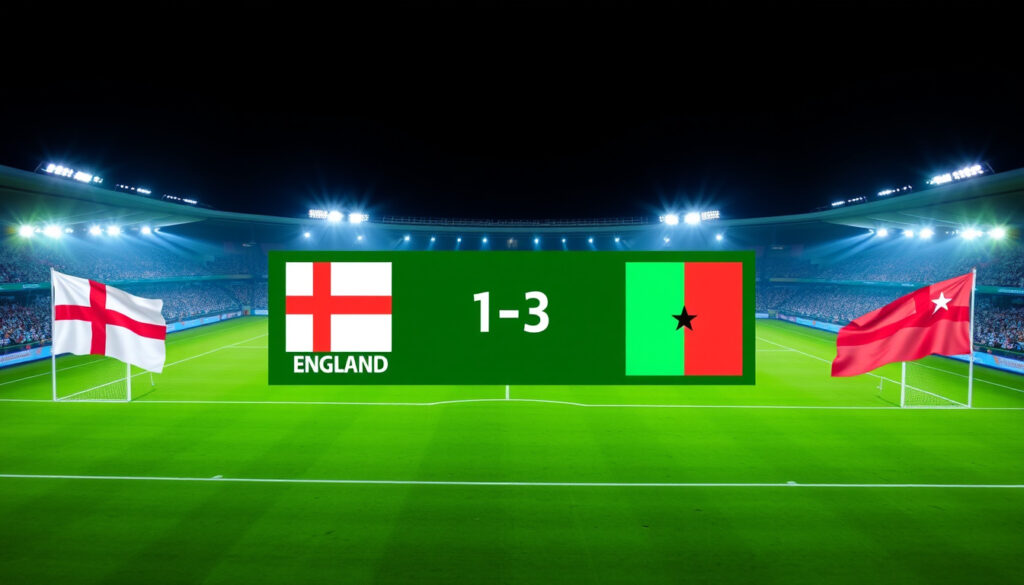
England vs Senegal Stats: 1-3 Result, H2H & Key Metrics
Senegal handed England their first defeat by an African opponent in 22 matches, winning 3-1 at the City Ground in Nottingham on June 10, 2025, despite England enjoying 61% possession and dominating territory for much of the contest. The result marked a historic first for Senegal while exposing England’s recurring struggle to translate territorial control into goals.
Final Score: England 1-3 Senegal · Date: 10 Jun 2025 · Venue: City Ground, Nottingham Forest · Ball Possession: England 61% – Senegal 39% · Total Shots: England 9 – Senegal 11
Quick snapshot
- Senegal won 3-1, their first ever win against England (ESPN match report)
- Harry Kane scored at 7′ for England; Senegal’s goals came at 40′, 62′, and 90+3′ (ESPN match report)
- Tuchel’s first defeat as England manager after four games in charge (ESPN match report)
- xG figures vary slightly between sources (FootyStats: 0.93/1.58 vs Flashscore: 1.38/1.86) (FootyStats stats, Flashscore match data)
- Exact date of prior England vs Senegal meeting not fully confirmed across sources (FootyStats head-to-head)
- Full substitution details not available across all sources (ESPN match page)
- Kane 7′ → HT 1-1 → Sarr 40′ → Diarra 62′ → Sabaly 90+3′ (ESPN match report)
- Halftime came with the score level, before Senegal’s second-half surge (FootyStats match data)
- England face 2026 FIFA World Cup qualifiers where their record remains intact (Andys Bet Club preview)
- Senegal carry a 24-game unbeaten streak into upcoming fixtures (ESPN match report)
| Stat | England | Senegal |
|---|---|---|
| Result | England 1-3 Senegal | — |
| Competition | International Friendly | — |
| Possession | 61% | 39% |
| Total Shots | 9 | 11 |
| Shots on Target | 4 | 9 |
| xG (FootyStats) | 0.93 | 1.58 |
| Corners | 5 | 3 |
| Yellow Cards | 2 | 1 |
| Big Chances | 3 | 3 |
Who won England v Senegal today?
Senegal emerged 3-1 victors against England at the City Ground on June 10, 2025—a result that carries weight well beyond a routine friendly. The win marked a historic first: Senegal became the first African nation to defeat England in 22 games against African opponents, a sequence spanning multiple decades of international football (ESPN match report). England captain Harry Kane had given the hosts an early lead with a strike in the seventh minute, and for a brief stretch the script looked familiar. But Senegal’s response was clinical. England fans expressed their displeasure audibly after the final whistle (ESPN match report).
Goal scorers and timeline
- 7′: Harry Kane scores for England (ESPN match report)
- 40′: Ismaïla Sarr equalises for Senegal; HT: 1-1 (ESPN match report)
- 62′: Habib Diarra puts Senegal ahead (ESPN match report)
- 90+3′: Cheikh Sabaly finishes off a counterattack (ESPN match report)
How did England lose against Senegal?
The scoreline flattered Senegal only partially. England controlled 61% of possession but converted that dominance into just four shots on target—a conversion rate that points to something deeper than poor luck. Manager Thomas Tuchel described his side as having been “frozen” in certain phases, a characterisation that raises questions about the squad’s mental readiness for opponents willing to sit deep and strike on the counter (ESPN match report).
Key moments
Beyond the goals, two sequences defined the match. First, a Jude Bellingham strike was ruled out for handball in the closing stages—a decision that denied England a lifeline when they were already chasing the game. Second, the period between the 40th and 62nd minute, when Senegal turned a halftime stalemate into a two-goal deficit, proved decisive.
Tactical breakdown
The xG differential underscores the disparity: England generated 0.93 expected goals while Senegal produced 1.58 from fewer opportunities, suggesting the visitors were more efficient in the moments that mattered (FootyStats stats). Senegal also created three big chances to England’s three—evidence that the result was not a one-off fluke but a product of superior tactical execution.
The possession-to-goals ratio reveals a structural issue. England recorded 61% of the ball and five corners, yet their 61% figure means little when Senegal’s 39% produced nine shots on target from 11 total attempts. The visitors’ game plan—absorbing pressure, winning second balls, and hitting quickly through wide areas—exposed gaps in England’s defensive shape when the wing-backs pushed forward.
Territorial dominance without penetration is a recurring critique of England’s attacking setup. Against a side willing to concede space, Tuchel’s men created only two clear chances from 61% possession—a conversion problem that surfaces repeatedly at major tournaments.
What are the head-to-head stats England vs Senegal?
The historical record between these two nations is remarkably thin, which makes the June 10 result all the more significant. Prior to 2025, England and Senegal had met only once—a 3-0 victory for England that dates to the early 2000s, with the exact date not fully confirmed across sources (FootyStats head-to-head). That sole prior meeting ended with a clean sheet for England, and until this friendly, Senegal had never troubled England’s defence in a competitive fixture.
Overall record
Through June 2025, the head-to-head record reads: England 1 win, Senegal 1 win, 0 draws. Two meetings. Two dominant victories for each side in different eras. The scarcity of fixtures between these teams means this result carries disproportionate weight in shaping perceptions of both squads, particularly given the stature of the opponent.
Recent encounters
Unlike England’s frequent meetings with fellow European nations, fixtures against African champions are rare on the calendar. The 2025 encounter is only the second head-to-head meeting in the nations’ histories, and it produced a result that inverts the prior narrative entirely. Senegal’s win extended their unbeaten run to 24 games—a streak that predates this encounter and suggests the result was less anomaly than confirmation of trajectory (ESPN match report).
| Meeting | Score | Venue | Competition |
|---|---|---|---|
| Prior H2H | England 3-0 | Unknown | Friendly / Qualifier |
| June 10, 2025 | England 1-3 Senegal | City Ground, Nottingham | International Friendly |
The implication: with only two meetings spanning decades, the June 2025 result risks being over-interpreted as a definitive shift in power—yet for Senegal it represents genuine historical progress against a traditionally dominant European side.
England vs Senegal match statistics
The headline numbers hide granular details that tell a more complicated story. England’s 61% possession came paired with just nine total shots—low for a side dominating the ball—and four on target. Senegal, by contrast, made the most of fewer opportunities: 11 total shots, nine on target.
Possession and shots
England’s corner count of five versus Senegal’s three suggests the home side spent more time in attacking positions, but corners are a poor proxy for quality. The foul counts (England 12, Senegal 18) indicate Senegal were more willing to play physically, a dimension that occasionally favoured them in winning second balls and disrupting England’s rhythm. Senegal’s goal at the 90+3 mark came from open play, not from a set piece—a sign their finishing was deliberate rather than fortunate.
Expected goals xG
One discrepancy worth noting: FootyStats reports xG as England 0.93, Senegal 1.58, while Flashscore records England 1.38, Senegal 1.86 (Flashscore match data). Both sources agree on the direction—Senegal outperformed their xG relative to England’s—but the absolute figures differ due to methodology variations. What both datasets confirm is that England’s 61% possession did not generate sufficient quality chances to justify the margin of defeat.
Possession statistics are only as useful as the chances they produce. England’s 61% share translated to 0.93 xG—evidence that ball control without creative penetration is a hollow metric at this level.
England squad updates and line up
Among the notable absences from England’s starting XI, defender John Stones was conspicuously absent—he pulled out of the squad ahead of the match for reasons not fully disclosed across sources. Kyle Walker, Anthony Gordon, and Declan Rice featured in the lineup that faced Senegal, with Dean Henderson starting in goal rather than the more familiar Jordan Pickford, who was rested or injured. Jude Bellingham, deployed in an attacking midfield role, saw his late goal chalked off for handball—a decision that summed up a frustrating evening for England’s creative outlets.
John Stones absence
The timing of Stones’ withdrawal left England’s defensive pairing less settled than Tuchel would have preferred. With the defender unavailable, Tuchel shuffled his backline, a reshuffle that showed in moments when Senegal exploited space behind the midfield. Whether this contributed directly to the result is speculative, but the disruption at centre-back is a factor worth tracking in England’s upcoming 2026 FIFA World Cup qualifiers.
Line up details
On the opposite side, Senegal’s XI featured Nicolas Jackson, whose assist for Sarr’s goal demonstrated the quality available to manager Aliou Cissé. Édouard Mendy anchored the defence from his goalkeeper position, while the scorers—Sarr, Diarra, and Sabaly—illustrated the distributed goal threat Senegal carry through their squad. The contrast in finishing quality between the two sides was visible in who got opportunities and who converted them.
“Senegal became the first African team to beat England in 22 games against African opponents, winning 3-1 in a friendly at Nottingham’s City Ground.”
— ESPN match report
“It was a night to forget for England who lost for the first time under Thomas Tuchel, who had overseen wins over all three World Cup qualifiers before this friendly.”
“Senegal handed England their first defeat by African opponents in 22 games.”
— Reuters via ESPN
espn.com, formacionpoliticaisc.buenosaires.gob.ar, mutating.com, footystats.org, aiscore.com
England’s 1-3 friendly loss to Senegal underscores the dramatic flips in their head-to-head records seen across recent international clashes.
Frequently asked questions
Have England qualified for the World Cup 2026?
As of June 2025, England had won all three of their World Cup 2026 qualifiers under Tuchel before this friendly loss. The defeat to Senegal does not affect qualification standing as it was a non-competitive fixture. England remain on track for automatic qualification based on their qualifying form.
Why is John Stones not in the England squad?
John Stones withdrew from the England squad before the Senegal friendly. The specific reason for his absence was not publicly disclosed by the Football Association. His withdrawal left Tuchel without one of his preferred centre-backs for the match.
Who is the current best England football player?
The question of who constitutes England’s best player is subjective and depends on the metric used. Harry Kane remains the captain and primary goalscorer, while Jude Bellingham and Declan Rice are widely considered among the most technically gifted players in the squad. Against Senegal, however, Kane’s early goal was not enough to prevent defeat.
Which country just qualified for the World Cup 2026?
Multiple nations have secured qualification for the 2026 FIFA World Cup through their respective qualifying campaigns as of June 2025. England’s place was confirmed through their European qualifying group, while several other nations also completed their qualification processes in the months leading up to the tournament.
What happened with Michelle Agyemang?
Michelle Agyemang is a Ghanaian footballer who has featured in women’s football discussions. This article focuses on the England men’s team match against Senegal. For specific details about Michelle Agyemang’s career, separate reporting would be required.
Did Foden leave England?
Phil Foden was not listed among the England players who featured prominently in the match report from the Senegal friendly. Squad rotation and competition for places means players occasionally miss selection, but there is no public record of Foden having left the national team setup permanently.
What is England’s form vs Senegal historically?
England and Senegal have met only twice historically, making the historical comparison limited. England won the first meeting 3-0, while Senegal’s 3-1 victory in June 2025 represents their first win in this fixture. The scarcity of meetings means limited conclusions can be drawn beyond these two results.
For England supporters, the message from Nottingham is clear: possession statistics without end product expose this side to disciplined opponents who can strike quickly. Tuchel’s next challenge—returning to competitive qualifying with the memory of Senegal’s clinical efficiency still fresh—begins now.
More related posts
 Vaibhav Suryavanshi: Age, IPL Career, and Controversies
 Richard Dean Anderson: What Happened to the MacGyver Star
 Ticket 2021 Websites for Gamification Summit – Trusted Sites
 Antony Starr: Biography, Career, and Personal Life
 Blue Jays vs. Yankees – Preview and Key Insights
 Elf on Shelf Ideas: Funny, Easy, Kids & Last-Minute
 What Time Is the Hockey Game Tonight – No NHL Games April 8
 Chat AI Guide: Compare Free Tools for Writing & Research
