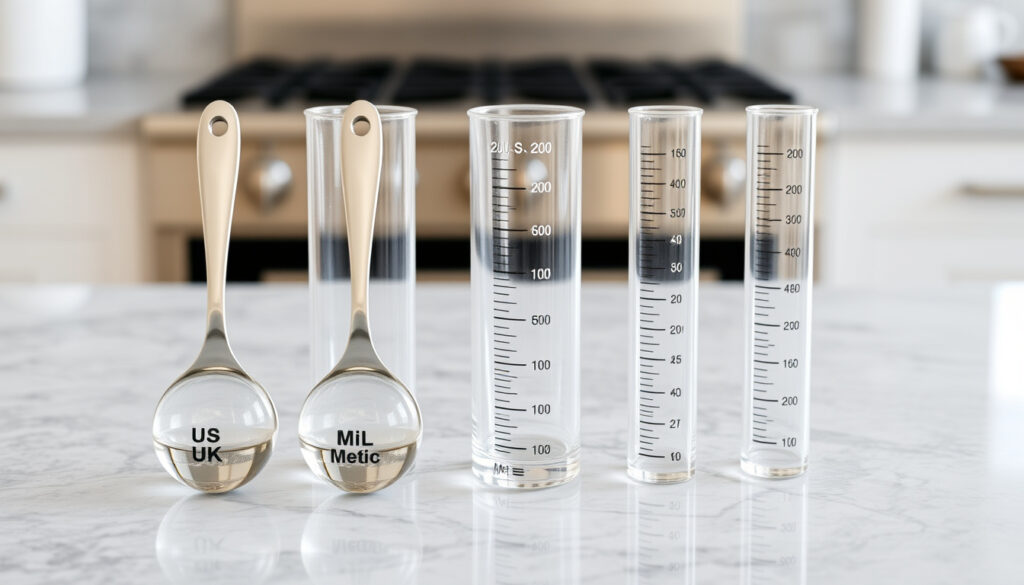
How Many mL in a Tablespoon – US, UK, Metric Conversions
When a recipe calls for a tablespoon of an ingredient, the exact volume in milliliters depends on where you are in the world. The United States, United Kingdom, Australia, and other regions each use slightly different standardized measurements for this common kitchen unit. Understanding these differences prevents errors in cooking, baking, and measuring medicine doses.
A tablespoon measures volume rather than weight, meaning the conversion to milliliters remains consistent regardless of whether you are measuring water, oil, melted butter, or liquid medicine. This guide provides precise conversion factors, regional variations, and practical advice for everyday use.
How Many mL in a Tablespoon?
The most commonly asked question in kitchens worldwide concerns the exact volume of a tablespoon. In the United States, one tablespoon equals exactly 14.7868 milliliters, though many recipes and nutrition labels round this to 15 mL for convenience. This distinction matters when precision counts, such as in baking or pharmaceutical applications.
The formula for converting tablespoons to milliliters follows a simple multiplication: mL = tablespoons × regional conversion factor. For US measurements, multiply by 14.7868. For UK traditional measurements, multiply by 17.758.
US legal standards define a tablespoon as 14.7868 mL, but many manufacturers round to 15 mL on nutrition labels. Always check whether your recipe follows legal standards or kitchen conventions.
Conversion Overview
| Measurement | US (mL) | UK Traditional (mL) | UK Metric (mL) |
|---|---|---|---|
| 1 Teaspoon (tsp) | 4.93 | 5 | 5 |
| 1 Tablespoon (tbsp) | 14.7868 | 17.758 | 15 |
| 2 Tablespoons | 29.5735 | 35.516 | 30 |
| 3 Tablespoons | 44.360 | 53.274 | 45 |
| ½ Cup (8 tbsp) | 118.3 | 142 | 120 |
These conversion factors apply uniformly to all liquids because tablespoon measurements represent volume, not weight. According to Unit Converters, the US customary system bases tablespoons on the fluid ounce, where one tablespoon equals exactly half a US fluid ounce (29.5735 mL ÷ 2).
Key Insights
- US tablespoons measure 14.7868 mL, commonly rounded to 15 mL in recipes and food labeling
- UK traditional tablespoons are larger at 17.758 mL, reflecting historical imperial measurements
- Modern UK and international standards align with 15 mL per tablespoon for consistency
- Australian tablespoons use 20 mL, making them notably larger than US or UK equivalents
- Teaspoon measurements are more consistent globally, typically ranging from 4.9 to 5 mL
- For pharmaceutical and medical dosing, always use standardized metric measurements rather than household spoons
Tablespoon vs Teaspoon: mL Equivalents
Understanding the relationship between tablespoons and teaspoons helps when recipes require fractional measurements. One tablespoon equals exactly three teaspoons in all standard measurement systems, though the actual milliliter values vary by region.
How Many mL in a Teaspoon?
A teaspoon in the United States contains approximately 4.93 milliliters, while UK, Australian, and other metric-aligned regions standardize the teaspoon at exactly 5 mL. This 0.07 mL difference seems minor but becomes significant when scaling pharmaceutical doses or precise chemical preparations.
The medical field standardizes on 5 mL per teaspoon precisely to eliminate ambiguity. Over-the-counter liquid medicines typically include dosing cups or syringes marked in milliliters rather than relying on variable household spoons.
For precise calculations, multiply tablespoons by the regional factor: US uses 14.7868, UK traditional uses 17.758, and metric uses 15. Always match your factor to the recipe’s origin country.
Teaspoon vs Tablespoon Differences
The practical difference extends beyond mere volume. Tablespoons typically feature wider bowls and longer handles, making them suitable for dishing ingredients, while teaspoons have narrower bowls designed for stirring and smaller portions. Recipe writers often abbreviate tablespoon as “tbsp” or “T” and teaspoon as “tsp” or “t.”
When following international recipes, recognizing these abbreviations prevents common conversion mistakes. A recipe from the United Kingdom using “tbsp” may call for 17.758 mL per tablespoon, while an American recipe using the same abbreviation expects 14.7868 mL.
The Exploratorium provides educational resources confirming that 1 tablespoon equals 15 mL and 1 teaspoon equals 5 mL in their standard measurement guides, reflecting the metric-aligned approach commonly taught in American education.
How Many mL in a UK Tablespoon?
British tablespoons present a particular challenge because two different standards coexist in everyday use. The traditional UK imperial tablespoon measures 17.758 milliliters, reflecting the historical British measurement system where pints contain 20 fluid ounces rather than the American 16 fluid ounces.
Modern British cooking increasingly adopts the metric-aligned 15 milliliters per tablespoon, especially in recipes written after the UK’s metrication transition. Package labeling in the UK also standardizes on 15 mL for nutritional information, aligning with European Union guidelines.
According to Metric Conversions, the discrepancy between traditional (17.758 mL) and modern (15 mL) UK tablespoons creates confusion when following older British recipes or comparing international sources.
When using British recipes, older publications may reference traditional 17.758 mL tablespoons, while modern publications typically use 15 mL. If a recipe seems slightly off in texture or consistency, the measurement standard used may be the cause.
Some sources mention 14.21 mL as a legacy UK measurement, though this appears less frequently in contemporary references. The English Kitchen conversion guide confirms that traditional UK tablespoons vary by context and recipe origin.
Converting Multiple Tablespoons to mL
Scaling tablespoon measurements requires simple multiplication by the appropriate conversion factor. Two US tablespoons equal 29.5735 mL (often rounded to 30 mL), while two UK traditional tablespoons equal 35.516 mL (rounded to 36 mL). These multiples appear frequently in recipes calling for quarter cups or similar fractions.
Three tablespoons of a liquid ingredient equals approximately 44.36 mL in US measurements or 53.274 mL in UK traditional measurements. This amount commonly appears in salad dressing recipes, marinades, and sauce proportions.
For larger quantities, eight tablespoons constitute half a cup. In US measurements, this equals approximately 118.3 mL. The UK traditional equivalent reaches 142 mL, while the metric-aligned standard sits at 120 mL. These differences compound significantly in recipes requiring multiple cups of liquid ingredients.
Online converters like those found at Omni Calculator provide quick conversions for any multiple, though understanding the underlying regional factors helps when working without digital tools.
Tablespoon mL for Water, Medicine, Butter, and Oil
A common misconception suggests that tablespoon volumes change depending on the substance being measured. In reality, tablespoons measure volume, meaning one tablespoon of water contains the same milliliters as one tablespoon of oil, melted butter, or liquid medicine. Weight differs dramatically between substances, but volume remains constant.
Tablespoon of Water or Medicine
One tablespoon of water equals 14.7868 mL in US measurements, 17.758 mL in UK traditional measurements, or 15 mL in metric contexts. This volume conversion applies directly to any liquid ingredient, including broths, juices, and extracts.
Medical dosing, however, demands extra caution. Pharmaceutical standards typically use 5 mL per teaspoon and 15 mL per tablespoon specifically to avoid confusion with variable household measurements. Sweet as Honey notes that medicine packaging explicitly states volumes in milliliters rather than tablespoon or teaspoon references for safety.
Never use kitchen tablespoons for measuring medicine unless specifically directed by healthcare professionals. Use the dosing devices provided with medications or calibrated syringes marked in milliliters.
Tablespoon of Butter or Oil
Tablespoons of melted butter or oil convert identically to liquid measurements because these substances become liquids when heated. One tablespoon of melted butter equals approximately 14.7868 mL (US) or 15 mL (metric), the same as water or any other liquid of similar density.
Solid butter presents a different consideration. While one tablespoon of solid butter also measures approximately 14 grams (roughly 14.8 mL by volume when melted), baking professionals prefer weighing butter rather than measuring by volume for accuracy. Recipe developers specify butter by weight precisely because packaged sticks vary in shape and density.
Cooking oils have densities slightly below water, meaning a tablespoon of oil weighs marginally less than a tablespoon of water. However, the volume-to-milliliter conversion remains the same at 14.7868 mL per US tablespoon. The Good Cooking conversion reference confirms these imperial-to-metric relationships for common kitchen ingredients.
Understanding Tablespoon Variations and Best Practices
Tablespoon measurements evolved from historical apothecary and domestic traditions rather than scientific standardization. Different regions developed their own conventions based on local serving sizes, utensils, and cultural practices. The 20th century brought increased standardization, yet regional variations persist in everyday cooking.
Modern recipe writers increasingly specify measurements in grams or milliliters rather than tablespoons to eliminate ambiguity. This trend proves particularly valuable in international recipe sharing, where a tablespoon means different volumes depending on the reader’s location and measurement conventions.
When following recipes from uncertain sources, consider the likely origin. American recipes typically follow US customary units. British recipes may use traditional (17.758 mL) or metric (15 mL) tablespoons. International recipes often assume the metric 15 mL standard. Adapting recipes between systems requires awareness of these differences.
For laboratory, pharmaceutical, or clinical applications requiring precision, consult official standards from the National Institute of Standards and Technology or equivalent national measurement institutes. These organizations maintain authoritative reference values for all customary units.
What Science and Sources Say
Comprehensive references confirm the established conversion factors. The Wikipedia article on tablespoons documents regional variations across multiple countries, noting that US tablespoons measure approximately 14.8 mL while Australian tablespoons reach 20 mL.
The United States tablespoon is officially defined as three teaspoons or half a US fluid ounce (approximately 14.8 mL).
— Wikipedia, Tablespoon
1 US tablespoon = 15 mL (rounded from 14.7868 mL for nutrition labeling)
— Unit Converters, Tablespoon Conversion Reference
Summary
A tablespoon contains different volumes depending on regional standards: approximately 14.8 mL in the United States, 17.8 mL in traditional UK measurements, and 15 mL in modern metric and nutritional labeling contexts. One teaspoon equals approximately 4.9 mL (US) or 5 mL (UK/metric), with three teaspoons composing one tablespoon across all systems.
These volume measurements apply consistently to water, oil, melted butter, and other liquids. Medical dosing should always follow labeled milliliter specifications rather than household spoon measurements. For precise needs, multiply tablespoon quantities by the appropriate regional conversion factor or consult authoritative conversion tools.
Related measurement guides include 13 cm to Inches – Exact NIST Conversion and Guide for length conversions and 10 CAD to USD – Current Rate and Trends for currency conversions.
Frequently Asked Questions
How many mL in a tablespoon of water?
One tablespoon of water equals 14.7868 mL in US measurements, 17.758 mL in UK traditional measurements, or 15 mL in metric contexts. The volume remains the same as any other liquid measured by tablespoon.
How many mL is a tablespoon of medicine?
Medical dosing standardizes on 5 mL per teaspoon and 15 mL per tablespoon. However, pharmaceutical packaging should always specify exact milliliter doses rather than relying on household spoon measurements, which vary significantly.
How many mL in a tablespoon of butter?
One tablespoon of melted butter equals approximately 14.8 mL (US) or 15 mL (metric), the same volume conversion as water or other liquids. Solid butter is often weighed in grams for precision, but volume measurements convert equivalently.
How many mL in a tablespoon of oil?
One tablespoon of oil measures approximately 14.8 mL using US standards or 15 mL using metric standards. Oil has slightly lower density than water, but the volume-to-milliliter conversion remains identical for tablespoon measurements.
How many mL in a UK tablespoon?
A UK tablespoon measures 17.758 mL using traditional imperial standards, though modern UK cooking and nutritional labeling often use the metric-aligned 15 mL. Check recipe publication date to determine which standard applies.
How many tablespoons in a cup?
One cup contains 16 tablespoons using US measurements (240 mL total) or 16 tablespoons using UK traditional measurements (283.9 mL total). The metric-aligned cup standard contains approximately 15-16 tablespoons depending on regional definitions.
More related posts
 News Today in the World: White House, China Mine, Iran Deal
 Conor McGregor: Net Worth, Losses, Legal Cases & Next Fight
 Rachel Dratch: Biography, Personal Life, and Career
 Porter Martone: Lip Injury, IIHF Warning, NHL Contract
 Oil of Oregano Benefits – Science-Backed Health Effects
 Wild vs Golden Knights: Head‑to‑Head, Predictions & Watch Guide
 Brennan Lee Mulligan: Career, Life, and Dropout Rumors
 Translate English to Korean – Best Free Tools 2025
