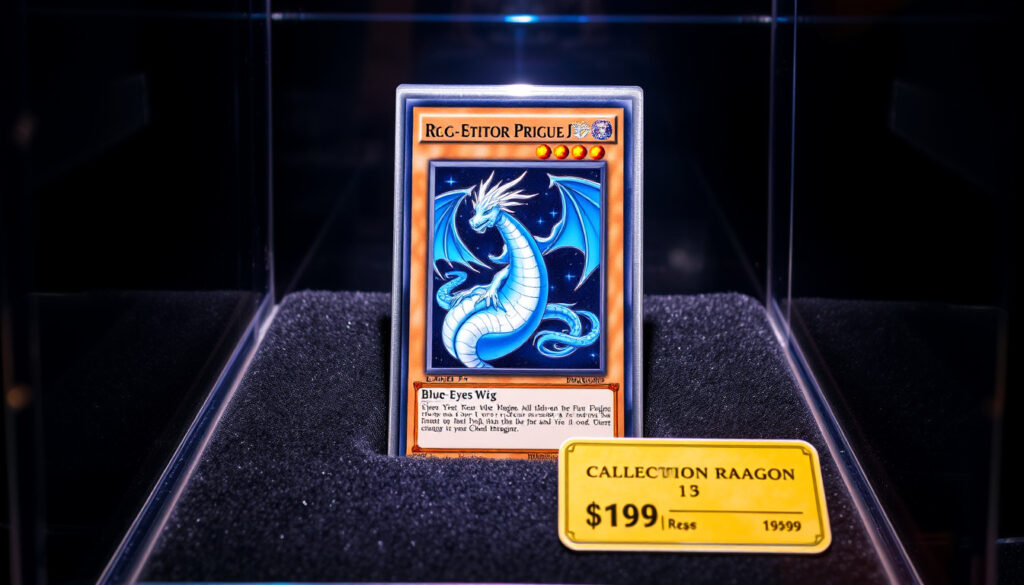
Blue-Eyes White Dragon: Price, Rarity & 1st Edition Guide
A 1st Edition LOB-001 Blue-Eyes White Dragon commands $810 ungraded, yet grading it with PSA or CGC can multiply that value by 8× to 30× depending on the grade you receive. Released March 8, 2002, the Ultra Rare from the original Legend of Blue Eyes White Dragon set remains one of Yu-Gi-Oh!’s most coveted collectibles.
ATK / DEF: 3000 / 2500 · Card Type: Normal Monster · Attribute: LIGHT · Level: 8 · Original Set: Legend of Blue Eyes White Dragon
Quick snapshot
- LOB-001 ungraded price sits at $810.00 (PriceCharting market data)
- PSA 10 graded value reaches $6,390.16 (PriceCharting market data)
- Ultra Rare designation from the 2002 Legend of Blue Eyes White Dragon set (Sports Card Investor rarity data)
- Exact pull odds from sealed Legend of Blue Eyes packs remain estimates (Sports Card Investor community data)
- High-grade auction records beyond $85,000 lack consistent documentation (CGC Cards auction reports)
- Released March 8, 2002 (Fanatics Collect release history)
- Raw price peaked at $4,100 on February 24, 2026 (Card Hedge price tracking)
- Fell to $350 low on June 24, 2025 (Card Hedge price tracking)
- PSA and CGC grading remains the standard for high-value transactions (PriceCharting grading guidance)
- Collector demand for pristine specimens keeps prices elevated despite volatility (Sports Card Investor market analysis)
| Attribute | Value |
|---|---|
| Card Name | Blue-Eyes White Dragon |
| Type | Normal Monster / Effect |
| Attribute | LIGHT |
| Monster Type | Dragon |
| Level | 8 |
| ATK / DEF | 3000 / 2500 |
How Much is a Normal Blue-Eyes White Dragon Worth?
The answer depends on one question above all others: condition. An ungraded Blue-Eyes White Dragon 1st Edition LOB-001 currently trades around $810.00 on the open market, according to PriceCharting’s aggregation of eBay and marketplace sales. Drop that card into a PSA 8 holder and the value jumps to $2,749.00. Push up to a PSA 10, and you’re looking at $6,390.16—roughly eight times the ungraded price.
The price curve steepens dramatically at the top. CGC has certified a Pristine 10 example valued at $25,650.00, while reported high-grade sales have reached $85,000 in select auction contexts.
Unlimited vs. 1st Edition Pricing
Two editions compete in the same set code, but they operate in different markets. The 1st Edition LOB-001 commands $810.00 ungraded. Its Unlimited counterpart (LOB-EN001) from 2004 sells for roughly $74.99 in ungraded condition—a tenfold difference that reflects collector preference for first print runs. The gap narrows but does not close in higher grades, where both versions become scarce, though the Unlimited variant is reportedly rarer in high grades than the 1st Edition despite its later release.
Factors Affecting Current Market Value
Three forces drive LOB-001 pricing: grading tier, edition type, and population size. PSA’s population data for EX-MT 6 shows 759 certified examples—a figure that shrinks rapidly as grade increases. The scarcity of high-grade specimens is the primary engine behind six-figure valuations.
A raw LOB-001 is worth roughly $810, but grading it with a reputable service like PSA or CGC can multiply that value by 8× to 30× depending on the grade you receive.
Which is the Rarest Blue-Eyes White Dragon?
Collector discussions consistently point to two candidates: the 1st Edition LOB-001 from the 2002 Legend of Blue Eyes White Dragon set, and the Dark Duel Stories (DDS) version exclusive to Japanese locale packs. Both carry prestige, but the DDS version appears less frequently in Western market data, making it harder to value with precision.
1st Edition Legend of Blue Eyes
The 1st Edition LOB-001 is an Ultra Rare from the March 2002 release. Only one printing run existed before Konami switched to Unlimited status. Among that run, the population of high-grade specimens is tiny: 759 at PSA EX-MT 6, with far fewer surviving in NM-MT 8 or above.
Dark Duel Stories Version
The DDS version remains a dark horse in rarity discussions. It rarely appears in public sales data from major tracking platforms, which limits transparency on exact population counts. Collectors treating it as the rarest do so largely on the basis of availability reports rather than verified census data.
Rarity claims often rest on supply perception rather than verified census counts. The only version with transparent population data is the 1st Edition LOB-001—everything else is best-guess territory until a grader publishes official numbers.
What’s So Special About Blue-Eyes White Dragon?
Blue-Eyes White Dragon occupies a unique place in Yu-Gi-Oh! history as one of the first monsters introduced in the franchise and the first Normal Monster to carry a 3000 ATK stat line under the original rules. Its presence in the original manga—wielded by protagonist Yugi Muto against Seto Kaiba—cemented its status as an icon long before the card game existed.
Role in Original Manga
In Kazuki Takahashi’s manga, the Blue-Eyes White Dragon is portrayed as one of the most powerful monsters available to a Duelist, capable of overwhelming most opposing forces. This narrative weight transferred directly into the card game when Konami adapted the manga into a competitive format.
Iconic Status in Yu-Gi-Oh
With 3000 ATK and 2500 DEF at Level 8, the card set a benchmark for Normal Monster power scaling. Konami later introduced stricter rules limiting Normal Monster stats, meaning Blue-Eyes White Dragon remains among the strongest non-effect Dragons ever printed in the original format.
Is Blue-Eyes White Dragon the Strongest?
In the context of the original 2002 format, yes—the 3000 ATK line was among the highest available to any single monster. Modern formats tell a different story. Cards like Blue-Eyes White Dragon now compete against Pendulum Monsters, Link Monsters, and oppressive floodgate effects that neutralize raw ATK advantages.
Stats Comparison
The card’s 3000 ATK / 2500 DEF remains impressive by historical standards, but it lacks the search, recycle, or protection effects that dominate current tournament play. Effect Monsters like True King Abraham or Thunder Dragon Colossus have replaced raw stat advantages with mechanics the Blue-Eyes cannot match without support cards.
Modern Meta Context
Blue-Eyes White Dragon decks remain popular in casual and casual-competitive formats. Cards like “The White Stone of Ancestors” and “Sage’s Stone” give the engine search capability, and “Blue-Eyes Spirit Dragon” provides protection against targeted destruction. The deck has aged into a viable rogue choice but does not top-tier competitive rankings.
Collectible value and competitive strength are not the same metric. Blue-Eyes White Dragon commands premium prices as a collectible while sitting outside the top competitive tiers in 2026.
How Do I Tell if My Blue-Eyes White Dragon is 1st Edition?
Authentication separates a $74.99 Unlimited copy from an $810.00 1st Edition specimen. Two visual checkpoints make the distinction straightforward once you know what to look for.
Check the Edition Mark
Turn the card over. The bottom right corner of the card back contains a small symbol indicating the print run. A “1st” stamp—sometimes formatted as “First Edition” or a numeric edition mark—distinguishes the 2002 print run from later Unlimited printings. If that mark is absent, the card is Unlimited.
Verify Printing Quality
1st Edition LOB cards from 2002 used a specific card stock and ink formulation that produces subtle texture differences from 2004 Unlimited prints. The holofoil pattern on Ultra Rare specimens catches light differently: 1st Edition holofoil tends toward a finer, more even dispersion. Common fakes in circulation replicate the artwork but fail to match the foil distribution and card stock weight of genuine 2002 prints.
| Specification | Detail |
|---|---|
| Card Name | Blue-Eyes White Dragon |
| Set Code | LOB-001 (1st Edition) / LOB-EN001 (Unlimited) |
| Set | Legend of Blue Eyes White Dragon |
| Rarity | Ultra Rare |
| Attribute | LIGHT |
| Monster Type | Dragon |
| Level | 8 |
| ATK | 3000 |
| DEF | 2500 |
| Release Date | March 8, 2002 |
| Publisher | Konami |
| Grading Services | PSA, CGC |
Six attributes span the card’s core identity: the Ultra Rare designation, LIGHT attribute, Dragon type, Level 8 classification, and the 3000/2500 stat line that defined Normal Monster power in 2002. Release date and set code pin the edition type.
Steps to Authenticate a Blue-Eyes White Dragon 1st Edition
Whether you’re buying, selling, or evaluating a collection, follow this four-step process to confirm your card’s edition status.
- Locate the edition mark. Flip the card face-down. Inspect the bottom right for a “1st Edition” or “First Edition” stamp. If absent, the card is from the Unlimited run.
- Check the set code. Confirm “LOB-001” on the card’s info panel—this designates the 1st Edition print from the 2002 Legend of Blue Eyes White Dragon set.
- Examine the holofoil pattern. Hold the card under a desk lamp. 1st Edition Ultra Rare cards from 2002 display a uniform, fine-grain holographic pattern. Reprints and fakes show coarser foil distribution or inconsistent sparkle.
- Submit for professional grading. For cards intended for sale above $500, submit to PSA or CGC. A slabbed grade removes authentication disputes and provides a standardized market value anchored to population data.
Fakes targeting 1st Edition LOB-001 have circulated since the early 2000s. The most common counterfeit markers include misaligned set codes, incorrect holofoil texture, and artwork color drift. When in doubt, a $25 grading submission is cheaper than a $810 mistake.
With stunning artwork and a unique holographic effect, the #LOB-001 sets the standard for all future Blue-Eyes White Dragon cards.
— CGC Cards (Grading Service Publication)
Finding one today in high-grade condition can be challenging, leading to strong demand in the marketplace.
— CGC Cards (Grading Service Publication)
For serious collectors, professional authentication through PSA or CGC is not a luxury—it is the instrument that converts a disputed claim into a verifiable market value. Without a grade, buyers and sellers negotiate from opposite assumptions. With a grade, both parties operate from the same population dataset, and the transaction completes faster and at higher confidence.
For sellers, the incentive is straightforward: a PSA 8 LOB-001 is worth $2,749.00 against $810.00 raw. The grading fee—typically $25 to $50 depending on service tier—returns fifteen to thirty times its cost in added value. For buyers, the calculus favors purchasing graded over raw when the premium is under 20 percent, because the grade removes condition ambiguity that raw cards cannot resolve without a third-party assessment.
Related reading: Blue Jays vs. Yankees
Frequently asked questions
What sets include Blue-Eyes White Dragon?
The Blue-Eyes White Dragon has appeared in multiple Konami releases since 2002, including the original Legend of Blue Eyes White Dragon set, the SD series, and various tins. The 1st Edition LOB-001 remains the flagship collectible edition.
How has Blue-Eyes White Dragon value trended?
Raw prices hit a low of $350 in June 2025, spiked to $4,100 in February 2026, and settled around $810 for ungraded copies as of April 2026. Graded specimens have shown more consistent upward pressure due to population scarcity.
Is Blue-Eyes White Dragon tournament legal?
Yes. The Blue-Eyes White Dragon is legal in tournament play under the latest Forbidden and Limited list. Its stats and effect comply with current format rules, though competitive viability depends on supporting cards rather than the Dragon’s standalone stats.
What are common fakes of 1st Edition Blue-Eyes?
The most prevalent counterfeits target 1st Edition LOB-001 with misaligned set codes, incorrect holofoil texture, and color drift in the artwork. Checking the edition mark and foil distribution under a lamp light remains the most reliable field authentication method.
Where to sell Blue-Eyes White Dragon cards?
Major platforms for raw cards include eBay, TCGPlayer, and Cardmarket. For graded specimens, dedicated auction houses and card-specific marketplaces yield better results. Always compare your card against PriceCharting or PSA population data before listing.
What accessories pair with Blue-Eyes decks?
High-grade toploader cases, team bags, and UV-protected storage boxes preserve card condition for graded slabs. For tournament players, dragon-themed card sleeves and playmats in the Blue-Eyes color scheme remain popular at regional and local events.
How rare is Blue-Eyes White Dragon in tins?
Tin-exclusive variants of Blue-Eyes White Dragon exist in reprinted forms, but these are not the 1st Edition LOB-001. Tin reprints carry different set codes and do not command the same collector premiums as the original 2002 printing.
More related posts
 Radio-Canada Acadie – Guide to History, Programs and Access
 Skilled Trades College of Canada: Programs, Reviews Guide
 New Balance Rebel v5 – Specs Weight Drop Review
 Why Should We Hire You? Sample Answers & Expert Tips
 El Diario de Hoy – El Salvador’s Enduring Newspaper Legacy
 How Many mL in a Tablespoon – US, UK, Metric Conversions
 Max Thieriot Movies and TV Shows: Full Filmography List
 Election Day Canada 2025: Date, How to Vote, and Key Facts
