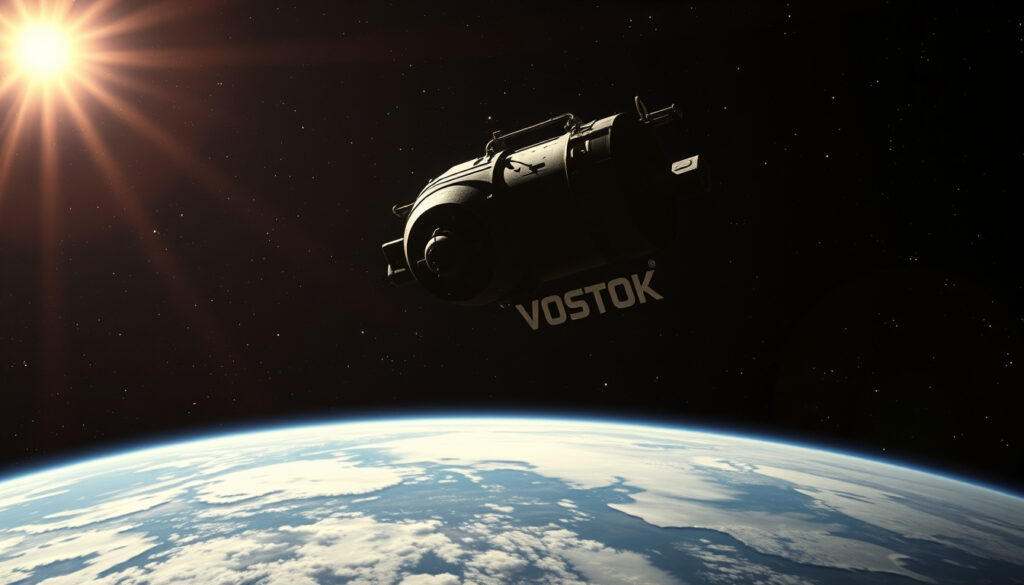
Yuri Gagarin: First Human in Space and His Death Mystery
Few figures from the Space Age capture the imagination quite like Yuri Gagarin. On April 12, 1961, he became the first human to venture beyond Earth’s atmosphere aboard Vostok 1, completing a single orbit in 108 minutes — but his tragic death in a MiG-15 crash seven years later remains one of space history’s most debated mysteries.
First human in space: Yes, on April 12, 1961 ·
Duration of spaceflight: 108 minutes ·
Age at flight: 27 years old ·
Nationality: Soviet ·
Date of death: March 27, 1968 (age 34) ·
Cause of death: Plane crash (MiG-15 training flight)
Quick snapshot
- First human in space on April 12, 1961 (The Planetary Society (nonprofit space advocacy group))
- Completed one orbit of Earth in Vostok 1 (Space Center Houston (NASA visitor center))
- Died in a MiG-15UTI crash on March 27, 1968 (BBC News (UK public broadcaster))
- Gagarin ejected from the capsule at 7 km altitude (The Planetary Society)
- Exact cause of the 1968 crash remains undetermined (BBC News; Wikipedia (community encyclopedia))
- Competing theories include bird strike, foreign object, or close encounter with another aircraft (BBC News)
- Cosmonaut Alexey Leonov claimed an unauthorized Su-15 sent the MiG into a spin (Universe Today (space news site))
- Declassified KGB report blamed airbase personnel for contributing to the accident (Wikipedia)
- April 12, 1961: Launched on Vostok 1, first human in space (The Planetary Society)
- March 27, 1968: Killed in MiG-15 training flight (BBC News)
- Annual Yuri’s Night celebrations every April 12 (Space Center Houston)
- Continued release of declassified documents may shed light on the crash (BBC News)
Nine key facts about Gagarin, one pattern: a life defined by a single 108-minute flight that changed history.
| Fact | Value |
|---|---|
| Full name | Yuri Alekseyevich Gagarin |
| Born | March 9, 1934 (Klushino, USSR) |
| Died | March 27, 1968 (age 34, Kirzhach, USSR) |
| Nationality | Soviet |
| Occupation | Pilot, cosmonaut |
| Known for | First human in space |
| Space mission | Vostok 1 (April 12, 1961) |
| Height | 1.57 m (5 ft 2 in) |
| Spaceship name | Vostok 1 |
Who was the actual first person in space?
The official record of Vostok 1
Yuri Gagarin’s Vostok 1 mission launched from what is now Kazakhstan and completed one orbit of Earth at an altitude of about 200 km (The Planetary Society). The Smithsonian National Air and Space Museum (U.S. space history museum) explicitly notes Gagarin and Alan Shepard as the first people to fly in space in 1961, though Shepard’s flight was suborbital.
Gagarin’s place in space history
- Gagarin was the first person to journey into outer space during the first successful crewed spaceflight (EBSCO Research Starters (academic research database)).
- His flight lasted 108 minutes from launch to landing (Space Center Houston).
- He ejected from the capsule at 7 km altitude and landed separately by parachute, a standard procedure for early Vostok missions (The Planetary Society).
Addressing alternative claims (e.g., suborbital flights)
Some point to earlier suborbital flights by test pilots, but the Smithsonian clarifies that “first person in space” refers to reaching orbit — a distinction that keeps Gagarin’s record intact.
Gagarin’s achievement wasn’t just a technological first — it redefined what humanity considered possible. For the Soviet Union, it was a propaganda triumph; for the world, it was proof that a human could survive the journey into orbit.
The pattern: Gagarin’s status as the first human in space is universally recognized by major space agencies and historians, with no serious challenge to his orbital record.
When did Yuri Gagarin go to space?
Countdown to launch from Baikonur Cosmodrome
The launch occurred on April 12, 1961, from the Baikonur Cosmodrome in present-day Kazakhstan (The Planetary Society). Gagarin, then 27 years old, was selected from a pool of 20 cosmonauts in 1960 (Wikipedia).
The date and time of the flight
- Launch time: 09:07 Moscow Time (The Planetary Society).
- Orbit: one revolution around Earth at an altitude of 200 km (The Planetary Society).
- Landing: 10:55 Moscow Time, 108 minutes after launch (Space Center Houston).
Immediate aftermath and global reaction
Gagarin became an international hero overnight. He embarked on a world tour, visiting dozens of countries and receiving the highest Soviet honors (Wikipedia). His face appeared on stamps, monuments, and buildings across the Eastern Bloc.
For Gagarin, fame came at a cost: he was never allowed to fly in space again. Soviet officials deemed him too valuable as a symbol to risk a second mission, confining him to ground roles and eventually a training flight that would prove fatal.
The implication: April 12 remains a fixed point in space history — “Yuri’s Night” is now a global celebration of human spaceflight, observed by NASA and space enthusiasts worldwide (Space Center Houston).
What happened to Yuri Gagarin in space?
The Vostok 1 mission timeline
- Liftoff and ascent: smooth, with Gagarin reporting “Poyekhali!” (“Let’s go!”) at ignition (The Planetary Society).
- Orbit: Gagarin observed Earth through the porthole, noted its beauty, and performed simple tasks like eating and drinking (Space Center Houston).
- Re-entry: the service module separation failed, causing Gagarin’s capsule to spin violently for 10 minutes before cables burned through (The Planetary Society).
- Ejection: at 7 km altitude, Gagarin ejected as planned and parachuted to the ground (The Planetary Society).
Gagarin’s experience during orbit
Gagarin later described weightlessness as “a feeling of infinite freedom” and noted that “the stars were very bright” (The Planetary Society). He also famously said, “I see Earth. It is so beautiful.” — a phrase that has become iconic.
Re-entry and landing
Despite the spin issue, Gagarin landed safely in the Saratov region. Because the landing was not inside the capsule, some questioned whether the flight counted as a complete spaceflight. The Fédération Aéronautique Internationale later confirmed that Gagarin met all criteria for the first human spaceflight (EBSCO Research Starters).
The violent spin during re-entry could have killed Gagarin — the fact that he survived it was a combination of good engineering and luck. It also meant that the official story downplayed the near-disaster, presenting a flawless mission to the world.
What this means: Gagarin’s flight was far from routine; it was a high-risk gamble that paid off, and the details only fully emerged decades later.
What were Yuri Gagarin’s last words?
His actual final transmission before the crash
Gagarin’s last known words before the crash on March 27, 1968, were routine radio communications with ground control. They contained no prophetic statements or political remarks (BBC News).
The famous misattributed quote “I see no God here”
A widely circulated quote — “I don’t see any God up here” — is often falsely attributed to Gagarin. Historical records indicate that Soviet Premier Nikita Khrushchev made the remark, not the cosmonaut. Gagarin himself was a practicing member of the Russian Orthodox Church and never made such a statement.
“I see Earth. It is so beautiful.” — Yuri Gagarin, during Vostok 1 orbit (1961)
“I don’t see any God up here.” — Soviet Premier Nikita Khrushchev (misattributed to Gagarin)
What is known about his last conversation
According to declassified flight logs, Gagarin’s final radio exchange with ground control consisted of standard altitude and heading reports. No distress call was received. The abrupt end of communication coincided with the MiG entering a steep dive from about 4,000 meters (BBC News).
The implication: Contrary to sensational claims, Gagarin’s last words offer no clue to the crash cause — they were prosaic, operational chatter.
Who was with Yuri Gagarin when he died?
The fatal training flight of March 27, 1968
On March 27, 1968, Gagarin departed from Chkalovsky Air Base near Moscow in a MiG-15UTI two-seat trainer. The flight was part of a requalification program for cosmonauts. Approximately 20 minutes after takeoff, the aircraft crashed in a wooded area near Novosyolovo, about 90 km from Moscow (BBC News). Both occupants were killed instantly.
Fellow pilot Vladimir Seryogin
Flight instructor Vladimir Seryogin, a decorated Soviet Air Force colonel, was in the front seat. Seryogin had extensive experience as a test pilot. Investigators found no evidence of pilot error or mechanical failure on the aircraft (Wikipedia (community encyclopedia)).
The investigation and theories of the crash
- A government commission ruled out technical defects but could not determine the exact cause. Theories include a bird strike, a foreign object (e.g., a weather balloon), or a close encounter with another aircraft (BBC News).
- Cosmonaut Alexey Leonov later claimed that an unauthorized Sukhoi Su-15 flew dangerously close, triggering an evasive maneuver that sent the MiG into an unrecoverable spin (Universe Today).
- A declassified KGB report from 2003 blamed airbase personnel for failing to close the flight zone to other aircraft, contributing to the accident (Wikipedia).
“The most plausible explanation is that an Su-15 flying below its supersonic ceiling passed close to the MiG and disrupted its airflow, causing a spin.” — Alexey Leonov, fellow cosmonaut (2007 interview)
The pattern: Decades after the crash, no single theory has been proven. The official cause remains “undetermined” — a rare admission of uncertainty from Soviet authorities.
iflscience.com, en.wikipedia.org, instagram.com, reddit.com, npr.org
Those seeking a comprehensive overview of both his mission and the lingering questions around his death can read more in Yuri Gagarins historic flight.
Frequently Asked Questions
How tall was Yuri Gagarin?
Gagarin stood 1.57 m (5 ft 2 in), making him one of the shorter cosmonauts — a requirement for the cramped Vostok capsule.
What was Yuri Gagarin’s nationality?
He was a Soviet citizen, born in the village of Klushino, Russian SFSR, USSR.
How do you pronounce Yuri Gagarin?
Yuri is pronounced YOO-ree (two syllables), and Gagarin is guh-GAH-rin (stress on second syllable).
What was the name of Yuri Gagarin’s spaceship?
His spacecraft was Vostok 1 (Russian for “East 1”).
Did Yuri Gagarin have any children?
Yes, he had two daughters: Yelena (born 1959) and Galina (born 1961).
What was Yuri Gagarin’s rank in the Soviet Air Force?
He attained the rank of colonel on November 6, 1963, after his historic flight.
How old was Yuri Gagarin when he went to space?
He was 27 years old at launch on April 12, 1961.
Gagarin’s legacy extends far beyond his 108-minute orbit. He became a global symbol of human daring, and his life — cut short at 34 — remains a powerful reminder of the risks and rewards of exploration. As historian Leon Trotsky noted in a different context, fate often reserves its sharpest twists for those who reach the heights. For Gagarin, the summit of space was matched by the suddenness of his fall — a mystery that, like the Mount Everest climbing enigma, continues to fascinate and elude.
More related posts
 TD Bank Customer Service 24/7 – Verified Contacts and Hours
 Ms. Rachel Net Worth, Family, Husband & Speech Delay Story (2025)
 Pain Under Right Rib Cage: 12 Causes & When to Worry
 Why Did Nala Ray Quit OnlyFans? Her Conversion and New Life
 Blue Mountains Guide: Day Trips, Towns & Why They’re Special
 How Tall is Taylor Swift? 5’10”, 6’2″ in Heels & Facts
 Mount Everest Peak: Height, Cost, Deaths, and the 2 PM Rule
 Divya Bharti: Death Reason, Mystery, and Facts (2025)
